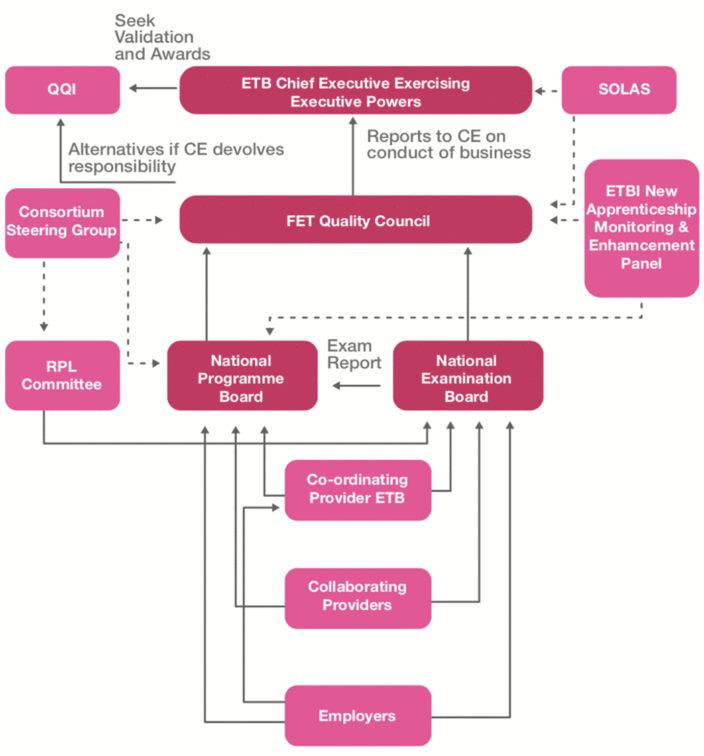
A set of common Quality Assurance Procedures have been developed in the context of an Education and Training Board sectoral approach and a National governance and oversight framework which is being established collectively by 16 ETBs to support the implementation of Quality Assured new national apprenticeship programmes.

The purpose of these procedures is to ensure the apprenticeship programme:

  • Is consistent with the Occupational Profile, developed by the Consortium Steering Group and approved by the Apprenticeship Council
  • Offers a valuable educational experience to apprentices.
  • Takes cognisance of the National Framework of Qualifications, and implements the procedures of QQI in relation to access, transfer and progression
  • Complies with QQI standards on validation criteria and is in line with QQI policy and quality assurance.
  • Upon completion of the programme, the qualified apprentice is fully qualified to perform the full range of activities and responsibilities outlined in the Occupational Profile. Those qualified should also have the skills to continue their learning as their occupation changes throughout their career. This requires the achievement of the intended programme learning outcomes and that he/she has demonstrated the skills of an autonomous apprentice.

Governance Structure

All governance units established in this QA system will have prescribed membership, terms of reference, operating procedures concerning their responsibilities and remit and are incorporated into the approved QA governance structure already established in Limerick and Clare Education and Training Board.

Off-the-Job Teaching

  • Training will be delivered off-the-job by ETB trainers/instructors, as per approved programme module requirements. Each module will specify the specification of the qualifications (academic, pedagogical and professional / occupational) and experience required of staff.
  • The trainers will be selected by each Education and Training Board, with governance and oversight from Limerick and Clare Education and Training Board as co-ordinating provider.
  • Trainers will be trained/upskilled as per professional development strategy set out by the programme.

The Teacher/Trainer/Instructor/Tutor duties include:

  • Introduce the apprentice to the off-the-job training location and provide a full briefing on the validated programme including the programme structure, content and assessment both on and off-the job.
  • Monitor the apprentice’s performance in the workplace and in off-the-job locations, and verify assessment evidence on Moodle.
  • Follow assessment guidelines in accordance with the QA requirements of the coordinating providers Quality Assurance Office / Personnel.
  • Ensure the validity, authenticity, currency and sufficiency produced by the apprentice as part of the assessment process.
    Provide apprentice with prompt, accurate and constructive feedback.

On-The-Job Mentoring

  • It is expected that workplace mentors will be senior stylists working within the salon.
  • Mentors will be appointed by the employer and approved by the National Programme Coordinator.
  • Employers and Workplace Mentors will be briefed on the Workplace Assessment by the programme team.
  • They will be trained to ensure that they understand their responsibility in relation to training and assessing an apprentice on-the-job, to industry and awarding body standard.
  • On-the-job assessments will be conducted by trained Workplace Mentors who will be given appropriate support and guidance to make work-based assessment decisions by liaising and engaging with the relevant tutor/s and the Provider Programme Leader.
  • Workplace Mentors are required to undertake a Workplace Mentor Training Programme and the Apprenticeship Programme Specific Employer Mentor Training Programme coordinated by Limerick and Clare Education and Training Board.

The Workplace Mentor’s duties include:

  • Ensure that the sequence of course work set out in the validated programme document is covered in the schedule of training and that the apprentice gets opportunities to gain experience in all of the relevant techniques.
  • Ensure that the apprentice is trained in the techniques and skills of the occupation on-the-job as per the programme specification and guide the apprentice in completing his/her programme workbook.
  • Assess the apprentice on each task as specified in the on-the-job assessment instrument specification and when he/she deems the apprentice to have reached the specified standard, complete and sign off the assessment sheet. The assessment sheet will be forwarded to the college/training centre for grading by the relevant module teacher in conjunction with the learning log as outlined in each module specification.
  • Guide the apprentice in the completion of his/her programme workbook.
  • Monitor the apprentices recording of their daily experiences in the Workbook.
  • Provide the apprentice with written feedback following each assessment.
Quality Assurance Procedures
include the following sections:
  1. QA Governance Structures and Procedures
  2. Quality Assurance Roles and Responsibilities
  3. Governance Reports
  4. Quality Assurance of Employers and Collaborating Providers
  5. Procedures and Guidelines for the design of new apprenticeship programmes
  6. Access, Transfer and Progression
  7. Teaching, Learning and Assessment Strategy
  8. Ongoing Periodic Reviews
  9. Information Provision
  10. Collaborations and Agreements
Appendices include:
  • Recognition of Prior Learning Policy and Procedure National Apprenticeship Appeals
  • Procedure
  • National Apprentice
  • Complaints Procedure Collaborating Provider Approval Procedure

Quality Assurance System

Limerick and Clare Education and Training Board as the co-ordinating provider will develop and implement a quality assurance system which is in compliance with the QQI Statutory Quality Assurance Guidelines for New Apprenticeship Programmes.

Structures

  • Apprenticeship Quality Council
  • National Consortium Steering Group
  • National Programme Board
  • National Examination Board
  • A Comprehensive Reporting Regime
  • Quality Assurance Arrangements with Employers
  • Quality Assurance of Collaborating Providers

Roles

  • National Programme Co-ordinator
  • Co-ordinating/Collaborating Provider Programme Leaders
  • Teachers/trainers/instructors/tutors
  • Provider tutor/supervisor
  • Senior Training Advisors/SOLAS Authorised Officers
  • Workplace Mentors
  • The Apprentice
Back to Top