
Development Timeframe
There are 10 main steps involved in developing a national apprenticeship, from research and formulating the outline proposal (Step 1) to rolling out the programme with employers and apprentices (Step 10). The steps are not necessarily linear, and a number may be taken in parallel. Based on the experience of consortia during 2015-2017, it is estimated that development of an apprenticeship will in general take between 12-15 months.
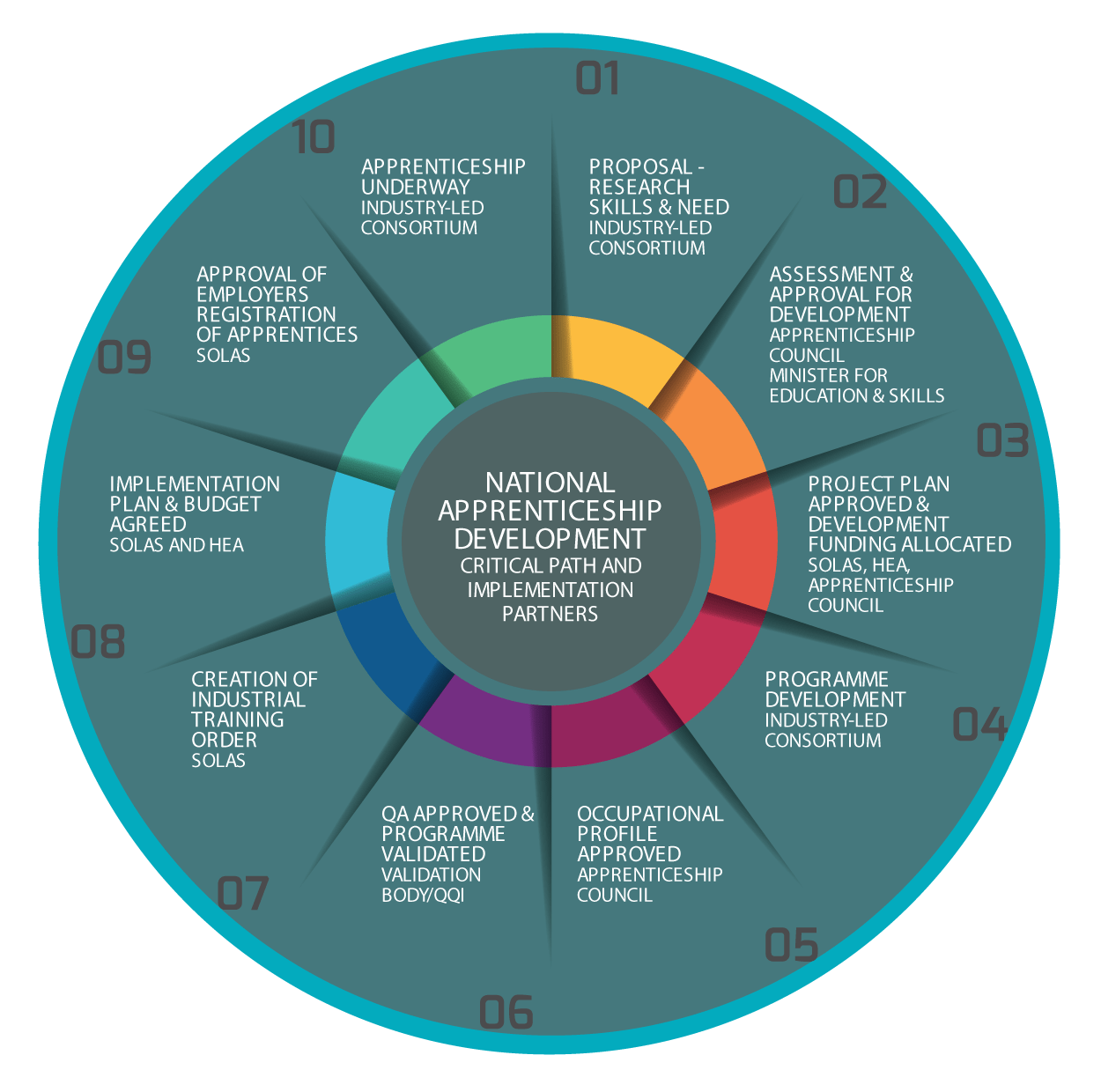
From Developing a National Apprenticeship © SOLAS 2018
To ensure that training and development of
hairdressing professionals will be formally regulated
Occupational Profile
Professional Hairdressers are qualified to work autonomously in a competent, professional and independent capacity, with the ability to use the knowledge, skills and competence required in their professional practice. They perform an extensive range of skills and services, from styling, colouring and cutting hair to performing scalp treatments.
Quality Assurance
A set of common quality assurance procedures have been developed in the context of an Education and Training Board sectoral approach and a national governance and oversight framework which is being established collectively by 16 ETBs to support the implementation of quality assured new national apprenticeship programmes.
Learning Outcomes
The actual award standard for a particular named award is the statement of minimum intended programme learning outcomes, or MIPLOs for short. This standard is approved at validation of the programme by QQI, the quality assurance agency for further and higher education and training in Ireland. The awards standards are maintained by the education and training providers.
The Department of Education and Skills sets policy and allocates funding for apprenticeship via the Further Education and Training Authority (SOLAS) and the Higher Education Authority (HEA).
The Apprenticeship Council is steering expansion of apprenticeship into new and existing sectors of the economy. Members of the Council are appointed by the Minister for Education and Skills. The Council has representatives from enterprise, the Irish Congress of Trade Unions, further and higher education and training bodies and the Department of Education and Skills.
The apprentice secures a contract with an employer to complete apprenticeship training. S/he participates in learning on-and off-the-job, becoming an autonomous and competent worker in a particular occupation. Apprentices are paid by the employer for the duration of their apprenticeship. Each apprentice agrees to abide by a formal Code of Practice for apprenticeship.
An apprenticeship gets under way when an approved employer formally registers and apprentice with SOLAS. Employers of apprentices provide on the job training, including mentoring support, pay the apprentice a salary throughout the duration of their apprenticeship, and release them for the off-the-job provision. For more information see the SOLAS ‘Apprenticeship Code of Practice for Employers and Apprentices’ on http://www.apprenticeship.ie
The consortium is the name given to the industry-led group which develops an apprenticeship programme and oversees its rollout and ongoing relevance to the needs of industry. The consortium includes education and training providers.
Further Education and Training Providers are key members of the apprenticeship consortia. They play a lead role in the development and in coordinating the delivery of the national apprenticeship programme and provide the off-the-job learning experience. There are 16 education and training boards nationally, and each of these have provision to offer off-the-job learning in multiple locations around the country.
SOLAS is the policy advice and funding agency for further education and training in Ireland. It has particular responsibility for apprenticeship, as set out in the 1967 Industrial Training Act. Key functions include designation of apprenticeship programmes on a statutory footing through Industrial Training Orders; a process for approval of employers’ suitability to train apprentices and a register of approved employers; and maintenance of a register of apprentices nationally.
QQI is the quality assurance agency for all further and higher education and training in Ireland, including apprenticeship. It is an awarding body and is responsible for maintaining the National Framework of Qualifications and for developing and monitoring access, transfer and progression policies for learners within the system.